Yamit Aharoni
RAZOR LABS

Case Study

InspectorPredictive Intelligence for Industrial Systems

AI Predictive Maintenance B2B Enterprise Data Visualization Desktop
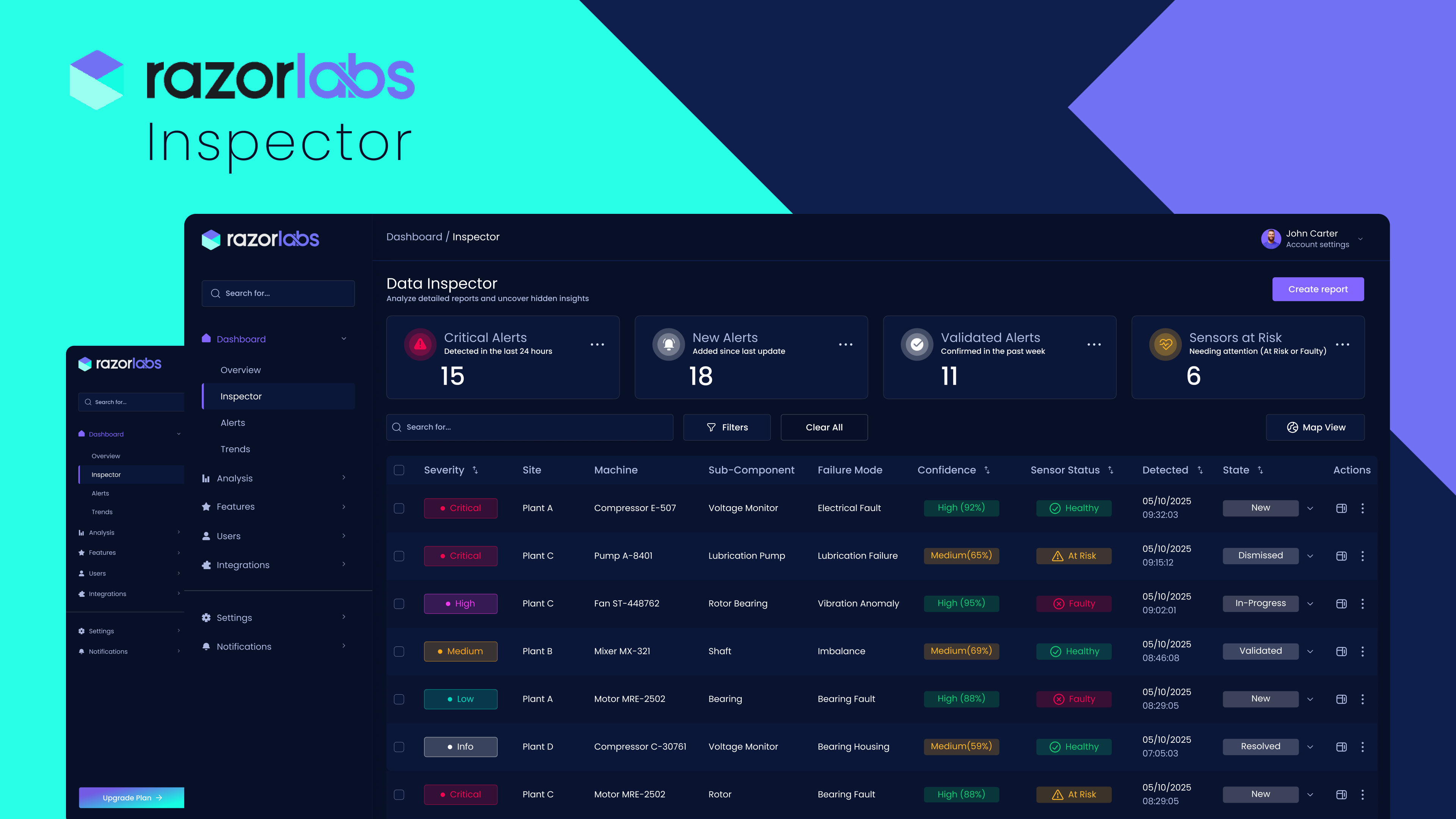
Razor Labs Inspector overview showing the data dashboard, alerts table, and industrial monitoring interface

About Razor Labs

AI-Driven Monitoring and Decision Support for Experts at Razor Labs

Razor Labs is an Israeli deep-tech company specializing in AI-driven predictive maintenance for heavy-industry machines in sectors such as mining, energy, and manufacturing. Their technology integrates data from multiple sensors - vibration, temperature, pressure, current, and video - to detect early signs of malfunction, analyze causes, and prevent downtime.

The Product: Inspector

The Inspector dashboard is an internal tool used by Razor Labs experts. It connects directly to the company’s data cloud and machine-learning algorithms, providing an interface for reviewing, validating, and improving AI-generated decisions. The goal: to transform complex multi-sensor data into clear, actionable insight for subject-matter experts and analysts.

Design Goal and Vision

The design challenge was to create a unified, intuitive interface that enables experts to:

  • Quickly identify relevant malfunctions within massive datasets.
  • Assess evidence and urgency levels (1-5 scale) with confidence.
  • Provide structured feedback and override AI decisions to continuously improve the models.

To design such a system, we began by deeply understanding the people behind the process - the experts, analysts, and operators who interact with the Inspector daily.

Research

Understanding the Experts Behind the System

Before defining any interface, the first step was to understand how Razor Labs' internal experts make decisions - what data they rely on, how they identify anomalies, and what prevents them from trusting the AI.

The research aimed to answer:

Research Goals

  • What information experts need to validate or dismiss algorithmic alerts?
  • How do they currently analyze failures and share insights?
  • What are the key friction points slowing down their daily workflow?

Research Methods

To uncover these insights, I used a mixed-methods approach combining qualitative and analytical research:

Stakeholder Interviews

With data scientists, domain experts (SMEs), and customer success managers to map how decisions flow between teams.

Task Observation

Observing experts as they analyzed alerts inside internal prototypes.

Journey Mapping

Identifying where handovers or confusion occurred between algorithm, analyst, and manager.

Heuristic Review

Reviewing existing screens to pinpoint usability gaps and data overload.

These research activities revealed recurring patterns across different roles, helping define the personas, workflow gaps, and opportunities that shaped the product direction.

Personas

Understanding the People Behind the Decisions

Based on recurring behavioral patterns, responsibilities, and workflow similarities, I identified four primary user groups representing the core ecosystem around the Inspector platform.

Dani - Subject Matter Expert (SME)

Goal

Determine the root cause of machine anomalies as quickly and accurately as possible.

Frustrations

  • Information scattered across multiple views.
  • Difficult to understand why the AI reached its conclusion.

Needs

  • Transparent evidence.
  • AI reasoning.
  • Fast validation tools.

Yossi - Customer Success Manager

Goal

Translate technical findings into clear customer communication.

Frustrations

  • Difficult to filter what customers actually need to know.
  • Too much manual communication.

Needs

  • Clear summaries.
  • Validation status.
  • Exportable insights.

Ronit - Senior Data Analyst

Goal

Review overridden AI decisions and continuously improve algorithm quality.

Frustrations

  • Missing traceability.
  • Inconsistent expert feedback.

Needs

  • Override history.
  • Confidence scores.
  • Structured reasoning.

Dana - Maintenance Manager

Goal

Understand which machines require immediate attention.

Frustrations

  • Too much raw data.
  • Poor prioritization.

Needs

  • High-level overview.
  • Clear severity hierarchy.

Key Findings

Across interviews, observations, and workflow analysis, several recurring patterns consistently appeared.

Data Fragmentation

Experts switched between multiple systems to build context.

Cognitive Overload

Excessive visualization made important insights difficult to identify.

Lack of Trust in AI

Users hesitated to rely on predictions without understanding the reasoning behind them.

Inefficient Collaboration

Analysts and SMEs documented feedback using inconsistent formats, making knowledge difficult to reuse.

These findings clarified that the challenge was not improving the AI itself, but improving how experts could understand, evaluate, and collaborate with AI decisions.

From Research to Solution

Defining the UX challenges that shaped the design vision.

Design Strategy

The core idea behind the redesign was to create a single, intelligent workspace where experts could investigate anomalies, understand AI reasoning, and provide feedback - all in one place.

Instead of juggling between graphs, logs, and systems, users now navigate a streamlined interface that mirrors their mental workflow:

detect → validate → comment → improve

The design followed three key principles:

Simplify the experience
eliminate cognitive overload by focusing only on what's actionable.

Visualize reasoning
show why the AI thinks something is abnormal, with transparency and evidence.

Empower experts
design an interface that treats AI as a collaborator, not a replacement.

The Flow Behind the Experience

To translate research into structure, I mapped the user journey into three main stages.

Stage 1 - Detection

AI flags an anomaly, automatically prioritizing machines according to severity, confidence, and operational impact.

The interface immediately surfaces the most critical alerts, allowing experts to focus attention where it matters first.

Stage 2 - Investigation

Experts explore supporting evidence through sensor data, historical patterns, and AI reasoning.

Instead of navigating multiple disconnected systems, all relevant information appears within a single investigation workspace.

Stage 3 - Validation

Experts confirm, override, or dismiss AI decisions while documenting the reasoning behind every action.

This feedback continuously improves future AI performance while maintaining full transparency and traceability.

System Architecture at a Glance

Machine Sensors

AI Detection Engine

Alert Prioritization

Expert Investigation

Decision & Feedback

Continuous Model Learning

The redesigned workflow connects every stage of the decision-making process into one continuous experience.

Instead of forcing experts to jump between disconnected dashboards, information now flows naturally from machine signals to AI analysis, expert validation, and continuous model improvement.

Key UX/UI Decisions

Every interface decision was intentionally tied back to a research finding, ensuring that each design choice solved a real user problem rather than introducing additional complexity.

Hierarchical Information Structure

The interface prioritizes the most actionable insights first, while secondary information progressively unfolds as users investigate deeper.

Color Logic by Severity

A consistent severity scale helps experts instantly distinguish between low-risk observations and critical machine failures across every screen.

Contextual AI Explanations

Instead of exposing raw algorithmic output, the interface explains why anomalies were detected directly within the investigation workflow.

Persistent Investigation Context

Important findings remain visible while users navigate between sensors, historical data, and supporting evidence, reducing cognitive load and unnecessary context switching.

Lightweight Visual Language

A restrained visual system minimizes fatigue during long investigation sessions, allowing complex industrial data to remain readable over extended periods.
Final Design

From Strategy to Interface

The following screens demonstrate how research insights were translated into a cohesive AI-powered investigation experience, helping experts quickly identify anomalies, understand AI reasoning, and make confident operational decisions.

Dashboard Overview

The redesigned dashboard provides experts with an immediate overview of system health, active incidents, and operational priorities.

Critical alerts, AI confidence, severity levels, and machine status are organized into a single workspace, allowing users to understand where attention is needed before starting an investigation.

Incident Investigation

Once an alert is detected, experts transition from monitoring into investigation.

Instead of switching between multiple tools, the system consolidates AI reasoning, sensor evidence, historical context, and supporting insights into a single investigation workspace.

This allows experts to quickly understand the incident, validate AI recommendations, and investigate root causes without losing context.

Expert Validation

After investigating the incident, experts review the AI recommendation before taking action.

Instead of treating AI as a black box, the interface keeps the human expert in control by supporting three possible outcomes - Confirm, Override, or Dismiss.

Every decision can be documented with supporting rationale, creating transparency, improving trust in the system, and continuously strengthening future AI recommendations through expert feedback.

Decision History

Every expert action becomes part of a transparent decision history.

Confirmed, overridden, and dismissed incidents remain fully traceable, allowing teams to understand what changed, who made the decision, and why.

By capturing expert rationale over time, the system creates an auditable feedback loop that improves collaboration, builds organizational knowledge, and continuously strengthens future AI predictions.

Together, these workflows transform AI from a prediction engine into a collaborative decision-support system, enabling experts to investigate faster, make confident decisions, and continuously improve future model performance.